Why You Should Not Sterilize in a Dressing Drum
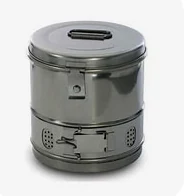
Many hospitals still use stainless steel drums with side holes to sterilize gauze, cotton and linen. Modern sterile processing practice advises against it. Here are the main reasons.
Five reasons
- It is not a validated sterile barrier. The side holes are opened so steam can enter, but holes do not stop microorganisms afterwards. Protection depends on someone closing the vents in time.
- Contamination can happen after the cycle. Between opening the sterilizer door and closing the vents, room air can reach the contents, and air can be drawn in as the load cools.
- Steam may not reach everything. Tightly packed gauze and linen in a closed cylinder with a few holes is hard to air-remove and hard to validate. Dense packs can stay damp.
- Every opening spoils the rest. A drum often holds dressings for many patients. Each time it is opened, the remaining items are no longer sterile.
- It is hard to control. Dents, stuck vents and worn lids go unnoticed. There is no tamper-evident seal, and the indicator inside cannot be seen without opening the drum.
What to use instead
Use a validated sterilization wrap, peel pouches, a rigid container with filters or valves used according to its instructions, or pre-sterilized single-use dressing packs. Prepare small packs for one patient or one procedure, and label each pack clearly. These options protect the contents until the moment of use.
If you must use drums for now
Close the vents immediately after the cycle, as the maker instructs. Use each drum for one procedure only. Place a chemical indicator inside, keep drums dry and undamaged, and store them in a clean, closed cupboard.
This is current best practice, not a law. Check your accreditation standard, infection control policy and the manufacturer's instructions.