STERILE PROCESSING · ARTICLE
Why You Should Not Sterilize Dressing Supplies in a Perforated Drum
Published 8 October 2026 · By SterilePro · 6 minute read
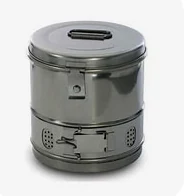
The stainless steel dressing drum with sliding side holes is a familiar sight in many wards, OTs and clinics. It has been used for decades to sterilize gauze, cotton and linen. Modern sterile processing practice, however, advises against relying on it. Here is why, and what to use instead.
What is this drum?
It is a round stainless steel container with a lid and ring-shaped or oval ventilation holes in the side, often called a Schimmelbusch drum. It is used for dressings, gauze and small linen packs.
How it is meant to work
- The drum is packed and the side vents are opened.
- Steam enters through the holes during the autoclave cycle.
- When the drum comes out, the vents are closed at once by turning the ring.
- The closed drum is stored until the contents are needed.
Why this is not recommended today
1. It is not a validated sterile barrier system
A sterile barrier system has two jobs: let steam in during the cycle and keep microorganisms out afterwards. Packaging that meets this need is tested, or validated, for it. In a vented drum the holes are open for the cycle and closed by hand afterwards, so protection depends on a person acting quickly and on a slide closure that is not validated as a microbial barrier. Holes alone are not a barrier. This is why the instructions for perforated sterilization cases say they allow sterilization but do not maintain a sterile barrier, so the case must be wrapped or used inside a validated system.
2. There is a contamination gap
From the moment the sterilizer door opens until the vents are closed and the drum has cooled, room air can reach the contents. As a hot load cools, air can be drawn in through any opening. A wrap or a filter stops microorganisms during this time. An open vent does not.
3. Steam penetration is hard to prove
A tightly packed cylinder of gauze or linen with a few small holes is a difficult load for air removal and steam penetration. Packs that are too dense can stay damp or fail to reach sterilizing conditions, and it is hard to validate one standard way of packing every drum.
4. Opening the drum again and again spoils the contents
A drum usually holds many dressings that are used over several days. Every time it is opened, the rest of the contents are no longer sterile. A pack made for one patient or one procedure avoids this problem.
5. Wear and weak control
Dents, loose rings, stuck vents and a poorly fitting lid let sterility fail without anyone noticing. A drum has no tamper-evident seal, and the indicator inside cannot be checked without opening it.
What do the standards say?
Modern packaging standards such as ISO 11607 and guidance such as AAMI ST79 expect sterile barrier systems to be validated and used according to the manufacturer's instructions. Rigid containers that are accepted today have filters or valves and gaskets tested for the purpose. Older documents, such as the Indian Standard IS 3831 for dressing drums, describe the vented drum as a container for sterilizing and storing dressings, and some suppliers still list it with instructions to close the vents right after the cycle. So you may still find drums in use. Current best practice has moved on, so check your own accreditation standard (for example NABH), your infection control policy and the manufacturer's instructions.
Safer alternatives
- Wrap dressing sets in a validated sterilization wrap.
- Use peel pouches or reels for small single-use dressing packs, closed with a validated sealer.
- Use rigid sterilization containers made for the purpose, with filters or valves and good gaskets, according to their IFU.
- Use pre-sterilized single-use dressing packs where possible.
- Make smaller packs for one patient or one procedure.
If you cannot change yet
These steps lower the risk. They do not turn the drum into a validated barrier.
- Follow the maker's instructions: open the vents for the cycle and close them immediately when the drum comes out.
- Use a drum for one procedure or one patient, and do not keep reopening it.
- Place a chemical indicator inside and check it. Follow your sterilizer tests, such as the Bowie-Dick test for pre-vacuum steam sterilizers and biological indicators, as your policy says.
- Keep drums dry, free of dents and with working vents and lids. Remove damaged drums.
- Store in a clean, dry, closed cupboard, handle gently and set a short storage limit in your policy.
- Record each load and plan to move to wraps or pouches.
- A perforated drum is a holder, not a validated sterile barrier.
- Sterility depends on closing the vents in time, every time.
- Opening the drum again and again makes the rest of the contents unsterile.
- Use a wrap, pouches or a validated rigid container instead.
- Check your local standard, policy and the manufacturer's IFU.
Related reading
- Quick guide: why not to sterilize in a drum (300 words)
- Packaging & Sterile Barrier Systems
- Steam Sterilization
- Storage & Event-Related Sterility
- Medical Device IFU
- CSSD MCQ chapters and practice tests
- CSSD interview questions
Frequently asked questions
Can I use a dressing drum with side holes for sterilization?
Modern sterile processing practice advises against relying on it, because it is not a validated sterile barrier system. If you must use one for now, follow the manufacturer's instructions strictly and plan to move to a validated option.
Are the holes in the drum a sterile barrier?
No. The holes let steam in, but they do not stop microorganisms after the cycle. The drum only protects the contents if the vents are closed in time and the closure works well, and this is not validated like a wrap, pouch or filtered rigid container.
What should I use instead of a vented drum?
Use a validated sterilization wrap, peel pouches, a rigid sterilization container with filters or valves used per its IFU, or pre-sterilized single-use dressing packs.
How long can items stay sterile in a drum?
There is no safe fixed time that fits every setting. Some suppliers quote a period under good storage, but this depends on closing the vents in time, storage conditions and how often the drum is opened. Follow your own policy and prefer packs for a single procedure.
Is this the same as a ban?
This article describes current best practice, not a law. Check your accreditation standard, infection control policy and the manufacturer's instructions for what applies in your hospital.
Sources and notes
- Manufacturer's instructions for a perforated sterilization case: states that a perforated case allows sterilization but does not maintain a sterile barrier.
- Supplier listing for sterilizing drums: describes opening the vents for the cycle and closing them right after removal.
- Summary of IS 3831:1979, dressing drums (Bureau of Indian Standards).
- Sterile processing lesson on sterile barrier systems.
This article is for education. It does not replace your facility policy, the manufacturer's instructions or local regulations. Please check the current version of any standard that applies to you.